In Florence, a short distance from the famous square by the same name, at number 16 of Via della Scala, stands one of the world’s oldest pharmacies: Officina Profumo-Farmaceutica di Santa Maria Novella, with its historic, artistic and handicraft legacy, which has thrived for centuries in uninterrupted symbiosis with the city of Florence. In its rooms, as in a jewel casket, the Officina hosts frescoes, furnishings and ancient implements of the pharmacist’s trade, alongside its products: a vast range of preparations to entice even the most demanding customer. Indeed, no one who enters the portal can ever forget the indescribable range of scents that linger in the air: this is the magic of potpourri, a sagacious mixture of flowers and herbs from the hills surrounding Florence. Its unmistakable fragrance is the fruit of lengthy seasoning in old terracotta jars. The origin of the Antica Farmacia goes back to the Dominican friars who in 1221 settled in Florence but it was officially founded in 1612 following a suggestion made by the Granduca di Toscana. The director and creator of the success of the Aromateria and its products was Fra’ Angiolo Marchissi, to whom the Granduca granted the right to use the name of Fonderia di Sua Altezza Reale. During the eighteenth century, thanks also to the ingeniousness of the many formulas created by the chemist-friars, the renown of the Farmacia crossed many borders and exports even reached the Indies and distant China. Since then, the spread of its products has constantly widened and though production is still restricted to the Head Office in Florence, other sales points have been opened in Roma, Milano, Forte dei Marmi, Lucca, Rimini, well as in London and Paris. Many of the Officina’s preparations have made history and have marked an epoch: the essences, as well as the famous and much requested perfumes, are still prepared to a large extent following the formulas studied in 1500 for Caterina de’ Medici. The history of Eau de Cologne is quite special in this regard. Indeed, it seems that this was the essence that Caterina de’ Medici, Queen of France, took with her to Paris, where it acquired the name of Eau de la Reine. Later, the Italian Giovanni Paolo Feminis, who moved to Cologne in 1725 and began to make it there, changed its name to Acqua di Colonia, as a tribute to the city where it was produced. Among the other preparations still produced following the old formulary of the Dominican friars is Aromatic Vinegar or Aceto dei Sette Ladri, very useful in the case of fainting-spells, whose formula dates back to 1600. Acqua Antisterica, today known as Acqua di Santa Maria Novella, in the past boasted a sedative and antispasmodic effect and was created by Fra’ Angiolo Marchissi in 1614. The Acqua di Rose, an excellent refreshing tonic for red eyes, was already available for sale in the second half of the fourteenth century. A very famous liqueur is Alkermes which held the sales record in the nineteenth century; also held in high regard are Elixir di China and Liquore Mediceo which was named in honour of the Medici family and the Elisir di Edimburgo, an excellent bitter. Not to be forgotten are the hair products and a wide range of products for treating the skin, such as Pasta di Mandorle, an excellent hand cream and Polvere Bianchire le Carni, a valid vegetable expedient for thoroughly cleansing the skin as well as milk, creams and oils for the body, bubble-baths and soaps. Soaps, hand-moulded one by one, aged for sixty days in ventilated cabinets and hand-wrapped are still produced with the machinery of the nineteenth century. Lastly, other favourites include the perfumed powders produced from the ground rhizome of the iris, the flower that grows freely on the hills around Florence in such profusion as to be adopted as the lily symbol of the city, still represented in its coat of arms. The Officina di Santa Maria Novella is once again also a herbalist’s shop. When the Dominican friars’ ancient formulas, no longer in use, were catalogued, a period of careful study revealed their up-to-date qualities and, in addition, the possibility to produce them. The Antica Farmacia has therefore enriched its lines with other exclusive products based on medicinal plants and herbs cultivated with natural methods and without the use of pesticides, thus offering customers the best service and a line of products which is all but complete. Thus the Officina’s past and present activities are integrated in a process of continuous osmosis which finds its natural complement, in the oldest tradition of pharmacies, in cultural activities which began in 1990 and which span various fields: from the artistic, with evenings devoted to the theatre, concerts and art exhibitions, to scientific, with conferences and book presentations. These events are held in an impressive room, originally a church abounding in frescoes, which was donated by the Acciaioli family to the friars in 1335 in recognition of their services and then transformed in 1848 into the actual Salesroom in order to meet the increased demands of the company. This and the other museum rooms of the Officina Profumo-Farmaceutica di Santa Maria Novella can be visited in small groups on appointment.
L'officina Farmaceutica di Santa Maria Novella
Florence Baptistery
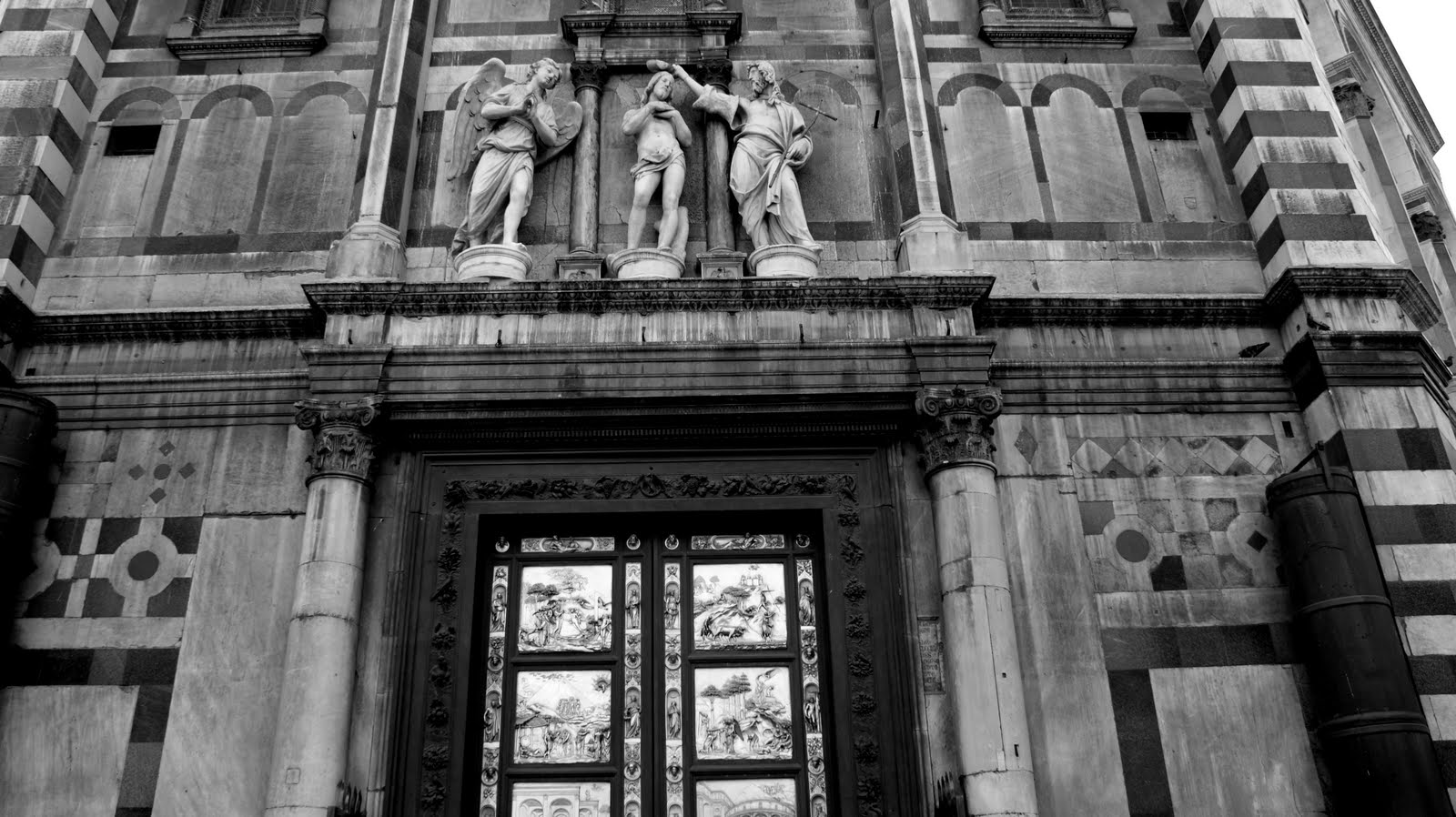

The Florence Baptistery or Battistero di San Giovanni (Baptistery of St. John) is a religious building in Florence (Tuscany), Italy, which has the status of a minor basilica.
The octagonal Baptistery stands in both the Piazza del Duomo and the Piazza di San Giovanni, across from the Duomo cathedral and the Giotto bell tower (Campanile di Giotto). It is one of the oldest buildings in the city, built between 1059 and 1128. The architecture is in Florentine Romanesque style.
The Baptistery is renowned for its three sets of artistically important bronze doors with relief sculptures. The south doors were done by Andrea Pisano and the north and east doors by Lorenzo Ghiberti.[1] The east pair of doors was dubbed by Michelangelo "the Gates of Paradise".
The Italian poet Dante Alighieri and many other notable Renaissance figures, including members of the Medici family, were baptized in this baptistery.[2] In fact, until the end of the nineteenth century, all Catholic Florentines were baptized here.
History
For a long time, it was believed that the Baptistery was originally a Roman temple dedicated to Mars, the tutelary god of the old Florence.[3]
The founder of this legend was not Dante, as sometimes claimed, but Giovanni Villani in his fourteenth-century Nuova Cronica on the history of Florence. However, twentieth-century excavations have shown that there was a first-century Roman wall running through the piazza with the Baptistery, which may have been built on the remains of a Roman guard tower on the corner of this wall, or possibly another Roman building. It is, however, certain that a first octagonal baptistery was erected here in the late fourth or early fifth century. It was replaced or altered by another early Christian baptistery in the sixth century. Its construction is attributed to Theodelinda, queen of the Lombards (570-628) to seal the conversion of her husband, King Authari.
Precedents
The octagon had been a common shape for baptisteries for many centuries since early Christian times. Other early examples are the Lateran Baptistery (440) that provided a model for others throughout Italy, the Church of the Saints Sergius and Bacchus (527-536) in Constantinople and the Basilica of San Vitale in Ravenna (548).
The earlier baptistery was the city's second basilica after San Lorenzo, outside the northern city wall, and predates the church Santa Reparata. It was first recorded as such on 4 March 897, when the Count Palatine and envoy of the Holy Roman Emperor sat there to administer justice.[citation needed] The granite pilasters were probably taken from the Roman forum sited at the location of the present Piazza della Reppublica. At that time, the baptistery was surrounded by a cemetery with Roman sarcophagi, used by important Florentine families as tombs (now in the Museo dell'Opera del Duomo).
Construction from about 1059
The present much larger Baptistery was built in Romanesque style around 1059, evidence of the growing economic and political importance of Florence. It was reconsecrated on 6 November 1059 by Pope Nicholas II, a Florentine. According to legend, the marbles were brought from Fiesole, conquered by Florence in 1078. Other marble came from ancient structures. The construction was finished in 1128.
An octagonal lantern was added to the pavilion roof around 1150. It was enlarged with a rectangular apse on the west side in 1202. On the corners, under the roof, are monstrous lion heads with a human head under their claws. They are early representations of Marzocco, the heraldic Florentine lion (see Loggia dei Lanzi).
Between the fourteenth and sixteenth centuries, three bronze double doors were added, with bronze and marble statues above them. This gives an indication that the Baptistery, at that time, was at least equal to the neighbouring cathedral in importance.
Exterior
The Baptistery has eight equal sides with a rectangular addition on the west side.
The sides, originally in sandstone, are clad in geometrically patterned colored marble, white Carrara marble with green Prato marble inlay, reworked in Romanesque style between 1059 and 1128. The pilasters on each corner, originally in grey stone, were decorated with white and dark green marble in a zebra-like pattern by Arnolfo di Cambio in 1293.
The style of this church would serve as prototype, influencing many architects, such as Leone Battista Alberti, in their design of Romanesque churches in Tuscany.
The exterior is also ornamented with a number of artistically significant statues by Andrea Sansovino (above the Gates of Paradise), Giovan Francesco Rustici, Vincenzo Danti (above the south doors) and others.
The design work on the sides is arranged in groupings of three, starting with three distinct horizontal sections. The middle section features three blind archestympani. Below each window is a stylized arch design. In the upper fascia, there are also three small windows, each one in the center block of a three-panel design. on each side, each arch containing a window. These have alternate pointed and semicircular
The apse was originally semicircular, but was it was made rectangular in 1202.
Andrea Pisano
As recommended by Giotto, Andrea Pisano was awarded the commission to design the first set of doors in 1329. The south doors were originally installed on the east side, facing the Duomo, and were transferred to their present location in 1452. The bronze-casting and gilding was done by the Venetian Leonardo d'Avanzano, widely recognized as one of the best bronze smiths in Europe. This took six years, the doors being completed in 1336. These proto-Renaissancequatrefoil panels, with the twenty top panels depicting scenes from the life of St. John the Baptist. The eight lower panels depict the eight virtues of hope, faith, charity, humility, fortitude, temperance, justice and prudence. The moulded reliefs in the doorcase were added by Lorenzo Ghiberti in 1452. There is a Latin inscription on top of the door: "Andreas Ugolini Nini de Pisis me fecit A.D. MCCCXXX" (Andrea Pisano made me in 1330). doors consist of 28
The group of bronze statues above the gate depict The Beheading of St John the Baptist. It is the masterwork of Vincenzo Danti from 1571.
Lorenzo Ghiberti
In 1401, a competition was announced by the Arte di Calimala (Wool Merchants' Guild) to design the baptistery north doors. The existing north doors had been a votive offering to spare Florence from a new scourge such as the Black Death in 1348. Seven sculptors competed, including Lorenzo Ghiberti, Filippo Brunelleschi, Donatello and Jacopo della Quercia [4], with 21-year old Ghiberti winning the commission. At the time of judging, only Ghiberti and Brunelleschi were finalists, and when the judges could not decide, they were assigned to work together on them. Brunelleschi's pride got in the way, and he went to Rome to study architecture leaving Ghiberti to work on the doors himself. Ghiberti's autobiography, however, claimed that he had won, "without a single dissenting voice." The original designs of The Sacrifice of Isaac by Ghiberti and Brunelleschi are on display in the museum of the Bargello.
It took Ghiberti 21 years to complete these doors. These gilded bronze doors consist of twenty-eight panels, with twenty panels depicting the life of Christ from the New Testament. The eight lower panels show the four evangelists and the Church Fathers Saint Ambrose, Saint Jerome, Saint Gregory and Saint Augustine. The panels are surrounded by a framework of foliage in the door case and gilded busts of prophets and sibyls at the intersections of the panels. Originally installed on the east side, in place of Pisano's doors, they were later moved to the north side. They are described by Antonio Paolucci as "the most important event in the history of Florentine art in the first quarter of the 15th century".
The bronze statues over the northern gate depict John the Baptist preaching to a Pharisee and Sadducee. They were sculpted by Francesco Rustici and are superior to any sculpture he did before. Rustici may have been aided in his design by Leonardo da Vinci, who assisted him in the choice of his tools.
Ghiberti was now widely recognized as a celebrity and the top artist in this field. He was showered with commissions, even from the pope. In 1425 he got a second commission, this time for the east doors of the baptistery, on which he and his workshop (including Michelozzo and Benozzo Gozzoli) toiled for 27 years, excelling themselves. These had ten panels depicting scenes from the Old Testament, and were in turn installed on the east side. The panels are large rectangles and are no longer embedded in the traditional Gothic quatrefoil, as in the previous doors. Ghiberti employed the recently discovered principles of perspective to give depth to his compositions. Each panel depicts more than one episode. In "The Story of Joseph" is portrayed the narrative scheme of Joseph Cast by His Brethren into the Well, Joseph Sold to the Merchants, The merchants delivering Joseph to the pharaoh, Joseph Interpreting the Pharaoh's dream, The Pharaoh Paying him Honour, Jacob Sends His Sons to Egypt and Joseph Recognizes His Brothers and Returns Home. According to Vasari's Lives, this panel was the most difficult and also the most beautiful. The figures are distributed in very low relief in a perspective space (a technique invented by Donatello and called rilievo schiacciato, which literally means "flattened relief".) Ghiberti uses different sculptural techniques, from incised lines to almost free-standing figure sculpture, within the panels, further accentuating the sense of space.
The panels are included in a richly decorated gilt framework of foliage and fruit, many statuettes of prophets and 24 busts. The two central busts are portraits of the artist and of his father, Bartolomeo Ghiberti.
Michelangelo referred to these doors as fit to be the "Gates of Paradise" (It. Porte del Paradiso), and they are still invariably referred to by this name. Giorgio Vasari described them a century later as "undeniably perfect in every way and must rank as the finest masterpiece ever created". Ghiberti himself said they were "the most singular work that I have ever made".
Preservation of original art
The "Gates of Paradise" situated in the Baptistery are a copy of the originals, substituted in 1990 to preserve the panels after over five hundred years of exposure and damage. To protect the original panels for the future, the panels are being restored and kept in a dry environment in the Museo dell'Opera del Duomo, the museum of the Duomo's art and sculpture. Some of the original panels are on view in the museum; the remaining original panels are being restored and cleaned using lasers in lieu of potentially damaging chemical baths. Three original panels made a US tour in 2007-2008, and then were reunited in a frame and hermetically sealed with the intention of making the panels appear in the context of the doors for public viewing.[5] One of the few copies made in the 1940s is installed in Grace Cathedral, in San Francisco.
Other contributors
The two porphyry columns on each side of the Gates of Paradise were plundered by the Pisans in Majorca and given in gratitude to the Florentines in 1114 for protecting their city against Lucca while the Pisan fleet was conquering the island.
The Gates of Paradise are surmounted by a (copy of a) group of statues portraying the The Baptism of Christ by Andrea Sansovino. The originals are in the Museo dell'Opera del Duomo. He then left to Rome to work on a new commission, leaving these statues unfinished. Work on these statues was continued much later in 1569 by Vincenzo Danti, a sculptor from the school of Michelangelo. At his death in 1576 the group was almost finished. The group was finally completed with the addition of an angel by Innocenzo Spinazzi in 1792.
Interior
The vast interior of the Baptistery recalls the interior of the Pantheon in Rome. The interior is rather dark, light entering through small windows in the ambulatory and through the lantern. The interior is divided in a lower part with columns and pilasters and an upper part with an ambulatory. The Florentines didn't spare any trouble or expense to decorate the baptistery. The interior walls are clad in dark green and white marble with inlaid geometrical patterns. The niches are separated by monolithic columns of Sardinian granite. The marble revetment of the interior was begun in the second half of the eleventh century.
The rectangular apse was faced with mosaics in 1225.
The building contains the monumental Tomb of Antipope John XXIII by Baldassare Coscia, designed by Donatello and his pupil Michelozzo Michelozzi. A gilt statue, with the face turned to the spectator, reposes on a deathbed, supported by two lions, under a canopy of gilt drapery. He had bequeathed several relics and his great wealth to this baptistery. Such a monument with a baldachin was a first in the Renaissance.
The mosaic marble pavement was begun in 1209. The geometric patterns in the floor are complex. Some show us oriental zodiac motifs, such as the slab of the astrologer Strozzo Strozzi. There was an octagonal font, its base still clearly visible in the middle of the floor. This font, which once stood in the church of Santa Reparata, was installed here in 1128. Dante is said to have broken one of the lower basins while rescuing a child from drowning. The font was removed in 1571 on orders from the grand duke Francesco I de' Medici. The present, and much smaller, octagonal font stands near the south entrance. It was installed in 1658 but is probably much older. The reliefs are attributed to Andrea Pisano or his school.
Mosaic ceiling
The Baptistery is crowned by a magnificent mosaic ceiling. The earliest mosaics, works of art of many unknown Venetian craftsmen (including probably Cimabue), date from 1225. The covering of the ceiling started under the direction of the Franciscan friar Jacopo da Torrita and was probably not completed until the fourteenth century.This mosaic cycle depicts in the three sections above the high altar, the Last Judgment with a gigantic, majestic Christ and the Angels of Judgment at each side by Coppo di Marcovaldo, the rewards of the saved leaving their tomb in joy (at Christ's right hand), and the punishments of the damned (at Christ's left hand). This last part is particularly famous: evil doers are burnt by fire, roasted on spits, crushed with stones, bit by snakes, gnawed and chewed by hideous beasts. These scenes remind us of later works showing us in grisly detail the horrors of hell, such as The Last Judgment or the panel Hell (from the triptychThe Garden of Earthly Delights), both by the Flemish painter Hieronymus Bosch.
Dante Alighieri, who grew up looking at these mosaics and these images of death and resurrection, must have been deeply impacted.
The other scenes on the ceiling depict different stories in horizontal tiers of mosaic : (starting at the top) Choirs of Angels, Thrones, Dominations, and Powers; stories from the Book of Genesis; stories of Joseph; stories of Mary and the Christ and finally in the lower tier : stories of Saint John the Baptist.
In the drum under the ceiling are many heads of prophets, attributed to Gaddo Gaddi, a friend of Cimabue.
The rect line
 Ferdinando I de' Medici, Grand Duke of Tuscany (30 July 1549 – 17 February 1609) was Grand Duke of Tuscany from 1587 to 1609, having succeeded his older brother Francesco I.
Arno River


The river originates on Mount Falterona in the Casentino area of the Apennines, and takes initially a southward curve. The river turns to the west near ArezzoFlorence, Empoli and Pisa, flowing into the Ligurian Sea at Marina di Pisa. With a length of 241 kilometers, it is the largest river in the region. Its main tributaries are: the Sieve (60 kilometers), Bisenzio (49 kilometers), Ombrone, Era, Elsa, Pesa and Pescia. The drainage basin amounts to more than 8,200 km² and drains the waters of the following sub-basins: passing through
- The Casentino, in the province of Arezzo, formed by the upper course of the river until the confluence with the Maestro della Chiana channel.
- The Val di Chiana, a plain dried in the 18th century, which, until the 18th century, was a marshy area tributary of the Tiber.
- The upper Valdarno, a long valley bordered from East by the PratomagnoSiena. massif and from West by the hills around
- The Sieve's basin, which flows in the Arno immediately before Florence.
- The middle Valdarno, with the plain including Florence, Sesto Fiorentino, Prato and Pistoia.
- The lower Valdarno, with the valley of important tributaries such as the Pesa, Elsa and Era and in which, after Pontedera, the Arno flows into the Tyrrhenian Sea. The river has a very variable discharge, ranging from minimum values such as 6 m³/s to more than 2,000. The mouth of the river was once near Pisa, but is now several kilometres westwards.
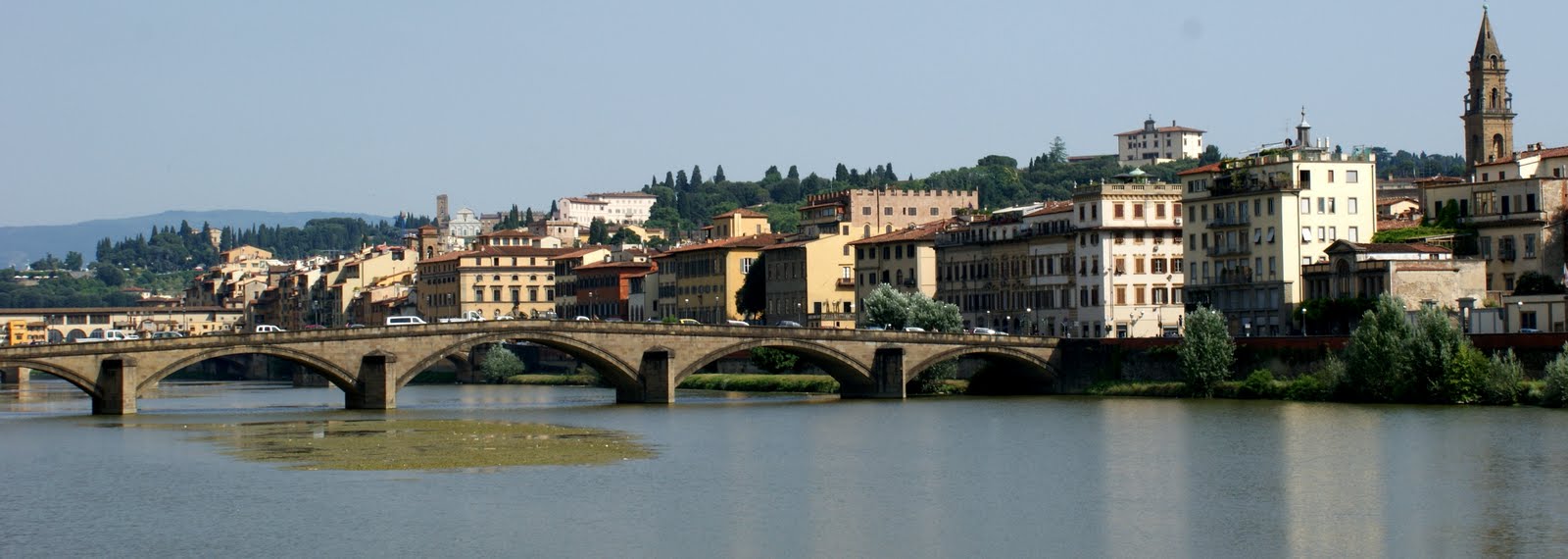
It crosses Florence, where it passes below the Ponte Vecchio and the Santa Trìnita bridge (built by Bartolomeo Ammanati, but inspired by Michelangelo). The river flooded this city regularly in historical times, the last occasion being the famous flood of 1966, with 4,500 m³/s after a rain of 437.2 mm in Badia Agnano and 190 millimetres in Florence, in only 24 hours.
The flow rate of the Arno is irregular. It is sometimes described as having a torrent-like behaviour, because it can easily go from almost dry to near-flood in a few days. At the point where the Arno leaves the Apennines, flow measurements can vary between 0.56 m³/s and 3,540 m³/s. New dams built upstream of Florence have greatly alleviated the problem in recent years.
A flood on November 4, 1966 collapsed the embankment in Florence, killing at least 40 people and damaging or destroying millions of works of art and rare books. New conservation techniques were inspired by the disaster, but even 40 years later hundreds of works still await restoration.
Looking for the Perfect Cameo


Cameo is a method of carving, or an object such as an engraved gem, item of jewellery or vessel made in this manner. It nearly always features a raised (positive) relief image; contrast with intaglio, which has a negative image. Originally, and still in discussing historical work, cameo only referred to works where the relief image was of a contrasting colour to the background; this was achieved by carefully carving a piece of material with a flat plane where two contrasting colours met, removing all the first colour except for the image to leave a contrasting background.
Today the term may be used very loosely for objects with no colour contrast, and other, metaphorical, terms have developed, such as cameo appearance. This derives from another generalized meaning that has developed, the cameo as an image of a head in an oval frame in any medium, such as a photograph.
TechniqueAncient and Renaissance cameos were made from semi-precious gemstones, especially the various types of onyx and agate, and any other stones with a flat plane where two contrasting colours meet; these are "hardstone" cameos. In cheaper modern work, shell and glass are more common. Glass cameo vessels, such as the famous Portland Vase, were also developed by the Romans.
Modern cameos can be produced by setting a carved relief, such as a portrait, onto a background of a contrasting colour. This is called an assembled cameo. Alternately, a cameo can be carved by the traditional, but far more difficult, method directly out of a material with integral layers or banding, such as (banded) agate or layered glass, where different layers have different colours.
Sometimes dyes are used to enhance these colours.
Cameos are often worn as jewelry, but in ancient times were mainly used for signet rings, although the largest examples were probably too large for this, and were just admired as objets d'art. Stone cameos of great artistry were made in Greece dating back as far as the 3rd century BC. The Farnese Tazza (a cup) is the oldest major Hellenistic piece surviving. They were very popular in Ancient Rome, especially in the family circle of Augustus. The most famous stone "state cameos" from this period are the Gemma Augustea, the Gemma Claudia made for the Emperor Claudius, and the largest flat engraved gem known from antiquity, the Great Cameo of France.
The technique has since enjoyed periodic revivals, notably in the early Renaissance, and again in the 18th and 19th centuries. The Neoclassical revival began in France with Napoleon's support of the glyptic arts, and even his coronation crown was decorated with cameos.
In Britain, this revival first occurred during King George III's reign, and his granddaughter, Queen Victoria, was a major proponent of the cameo trend, to the extent that they would become mass produced by the second half of the 19th century.
The visual art form of the cameo has even inspired at least one writer of more recent times, the 19th-century Russian poet Lev Mei, who composed a cycle of six poems entitled Камеи (Cameos, 1861), as reflections on each of the Roman rulers from Julius Caesar to Nero. In 1852 Théophile Gautier titled a collection of his highly polished, lapidary poems Emaux et Camées (Enamels and Cameos).
Roman glass cameos
During the Roman period the cameo technique was used on artificial glass blanks, in imitation of objects being produced in agate or sardonyx. Cameo glass objects were produced in two periods; between around 25 BC and 50/60 AD, and in the later Empire around the mid-third and mid-fourth century. Roman glass cameos are rare objects, with only around two hundred fragments and sixteen complete pieces known, only one of which dates from the later period.During the early period they usually consisted of a blue glass base with a white overlying layer,Blanks could be produced by fusing two separately cast sheets of glass, or by dipping the base glass into a crucible of molten overlay glass during blowing.[4] The most famous example of a cameo from the early period is the Portland Vase. but those made during the later period usually have a colourless background covered with a translucent coloured layer.
Shell cameos
The earliest known use of shell for cameo carving was during the Renaissance, in the 15th and 16th centuries. Before that time, cameos were carved from hardstone. The Renaissance cameos are typically white on a grayish background and were carved from the shell of a mussel or cowry, the latter a tropical mollusk.
In the mid 18th century, explorations revealed new shell varieties. Helmet shells (Cassis tuberosa) from the West Indies, and queen conch shells (Eustrombus gigas) from the Bahamas and West Indies, arrived in Europe. This sparked a big increase in the number of cameos that were carved from shells. Conch shells carve very well, but their color fades over time.
After 1850 demand for cameos grew, as they became popular souvenirs of the Grand Tour among the middle class.
Cameo subjects
Classically the designs carved onto cameo stones were either scenes of Greek or Roman mythology or portraits of rulers or important dignitaries. In history, agate portrait cameos were often gifts from royalty to their subjects. These antique cameos, some more than 2000 years old, are either displayed in museums or are in private collections.
Il Biancone


The Fountain of Neptune is a fountain in Florence, Italy, situated on the Piazza della Signoria (Signoria square), in front of the Palazzo Vecchio.
This work by Bartolomeo Ammannati (1563–1565) and some assistants, such as Giambologna, was commissioned on the occasion of the wedding of Francesco I de' Medici with grand duchess Johanna of Austria in 1565. The assignment had first been given to Baccio Bandinelli, who designed the model but he died before he could start working on the block of Apuan marble.
The Neptune figure, whose face resembles that of Cosimo I de' Medici, was meant to be an allusion to the dominion of the Florentines over the sea. The figure stands on a high pedestal in the middle of an octagonal fountain. The pedestal in the middle is decorated with the mythical chained figures of Scylla and Charybdis. The statue of Neptune is a copy made in the nineteenth century, while the original is in the National Museum.
However, when the work was finished, it was not appreciated in particular by the Florentines, who called it Il Biancone (the white giant).
Work continued on this fountain during the next ten years. Ammannati, with the assistance of the best Florentine sculptors and casters, added around the perimeter of the basin, in a mannerist style, suave, reclining, bronze river gods, laughing satyrs and marble sea-horses emerging from the water. The monumental marble and the dynamic bronzes give nevertheless a coherent impression. The fountain served as an example for future fountain-makers.
The fountain has suffered a great deal of damage during the centuries. It was used as a washbasin for laundry at the end of the 16th century. It was vandalized on January 25 1580. A satyr was stolen during the carnival in 1830. It was damaged again by the Bourbon bombardments of 1848. Consequently, it has been the object of several restorations and substitutions. On August 4, 2005, the statue was the target of three vandals who climbed it, damaging one of the hands and the trident of Neptune. The act was recorded by security cameras. The statue was restored by 2007. Since then, security on the fountain has been taken very seriously. In late 2007, the statue was the target of attempted vandalism by three teens. The security cameras and nearby police ensured that no damage came to the fountain again and the three were arrested.
(Firenze, June 2008)

Hotel Pendini

The History of Hotel Pendini is related with the 2,000 years history of Piazza della Repubblica. Florence was founded by the Romans in 50 a.c. as a camp, military base to fight the nearby Etruscan village of Fiesole, who was rebel to the Roman Empire. The campus had the shape of a rectangle, crossed by straight streets and delimited by a surrounding wall that followed the nowadays path of Via Tornabuoni, via dei Cerretani, via del Proconsolo. At the intersection of the two main streets there was a rectangular square, called "forum". It was the main place where people used to meet. Public ceremonies and a market were held there. The actual Piazza della Repubblica is founded in the same place of the antique roman "forum". The goal was to refresh the medieval Florence with a little bit of the atmosphere of Paris, the most important capital in Europe at that time. In 1879 the building with the big arch was terminated. At that time, Mrs. Pendini founded on the top floors of that building the hotel that still holds her family name. From 1930 the hotel changed several owners, from one family to another, but still today the clients of Hotel Pendini are welcomed in the atmosphere and style of the "Belle Epoque". The Hotel is located on the top floors of the building. An elevator will bring you from ground floor to the reception on the fourth floor.
(Firenze, June 2008)
Gentile da Fabriano

Gentile da Fabriano (c. 1370 - c. 1427) fue un pintor italiano, uno de los principales exponentes del estilo gótico internacional en Italia.
Se lo supone nacido en Fabriano, en la región del Marche, al este de Italia. Gentile quedó huérfano a temprana edad, tras la muerte de su madre y la ordenación como monje de su padre. Fue puesto en aprendizaje a un pintor toscano. Se conoce poco de su carrera temprana; hacia el año 1408 se lo sabe trabajando en Venecia. Entre 1409 y 141 pintó un fresco, hoy perdido, en el palacio del Dux, que representaba la batalla naval entre las fuerzas venecianas y las de Otón III. Se trasladó posteriormente a Brescia. Hacia 1420 regresó a Florencia, donde pintó en 1423 su pieza más famosa, la Adoración de los Magos; originalmente diseñada como altar para una iglesia, aunque hoy se conserva en las galerías Uffizi.
En 1425 se trasladó a Siena y luego a Orvieto, donde pintó el famoso fresco de la virgen María y el niño en la catedral. Ese mismo año, pintó el políptico Quaratesi, un sextuple panel de madera encargado por la familia Quaratesi para el altar mayor de la iglesia de San Niccolo sul'Arno en Florencia. El altar se conservó allí hasta 1830, pero luego fue desmembrado y vendido por partes. Los cuatro paneles laterales se pueden ver en las galerías Uffizi, y los dos restantes en Hampton Court, Gran Bretaña, y la National Gallery of Art of Washington, Estados Unidos, respectivamente.
En 1427 murió en Roma, mientras trabajaba en varios frescos en la basílica de San Juan de Letrán. Nada se conserva de estos.
Leonardo

The Adoration of the Magi is an early painting by Leonardo da Vinci. Leonardo was given the commission by the Augustinian monks of San Donato a Scopeto in Florence, but departed for Milan the following year, leaving the painting unfinished. It has been in the Uffizi Gallery in Florence since 1670.
he Virgin Mary and Child are depicted in the foreground and form a triangular shape with the Magi kneeling in adoration. Behind them is a semicircle of accompanying figures, including what may be a self-portrait of the young Leonardo (on the far right). In the background on the left is the ruin of a pagan building, on which workmen can be seen, apparently repairing it. On the right are men on horseback fighting, and a sketch of a rocky landscape.
The ruins are a possible reference to the Basilica of Maxentius, which, according to Medieval legend, the Romans claimed would stand until a virgin gave birth. It is supposed to have collapsed on the night of Christ's birth (in fact it was not even built until a later date). The ruins dominate a preparatory perspectivepalm tree in the centre has associations with the Virgin Mary, partly due to the phrase 'You are stately as a palm tree' from the Song of Solomon, which is believed to prefigure her. Another aspect of the palm tree can be the usage of the palm tree as a symbol of victory for ancient Rome, whereas in Christianity it is a representation of martyrdom—triumph over death—so in conclusion we can say that the palm in general represents triumph. The other tree in the painting is from the carob family, the seeds from the tree are used as a unit of measurement. They measure valuable stones and jewels. This tree and its seeds are associated with crowns suggesting Christ as the king of kings or the Virgin as the future Queen of heaven, also that this is nature's gift to the new born Christ. As with Michelangelo's Doni Tondo the background is probably supposed to represent the Pagan world supplanted by the Christian world, as inaugurated by the events in the foreground.
Leonardo develops his pioneering use of chiaroscuro in the image, creating a seemingly chaotic mass of people plunged into darkness and confusion from which the Magi peer towards the brightly lit figures of Mary and Jesus, while the pagan world in the background carries on building and warring unaware of the new revelation.
Alberto Durero
 Durero nació el 21 de mayo de 1471 en Núremberg, ciudad en la que estuvo íntimamente unido. Su padre, Alberto Durero el Viejo, era orfebre y fue el primer maestro de su hijo. De su primera formación, el joven Durero heredó el legado del arte alemán del siglo XV, en el que estaba muy presente la pintura flamenca del gótico tardío. Los artistas alemanes no tenían dificultad en adaptar su propia tradición gótica a la de artistas flamencos como Robert Campin, Jan van Eyck y, sobre todo, Rogier van der Weyden.
El concepto empírico del mundo de la gente del norte (fundamentado más en la observación que en la teoría) era el nexo común. Durante el siglo XVI, el fortalecimiento de lazos con Italia a través del comercio y la difusión de las ideas de los humanistas italianos por el norte de Europa infundieron nuevas ideas artísticas al mundo del arte alemán, de tradición más conservadora.
Para los artistas alemanes resultaba difícil conciliar su imaginería medievalantigüedad clásica, los temas mitológicos y las figuras idealizadas. La tarea que Durero se planteó fue la de proveer a sus compatriotas de un modelo con el que pudieran combinar el interés empírico por los detalles naturalistas con los aspectos más teóricos del arte italiano. -representada con ricas texturas, colores brillantes y figuras con gran lujo de detalle- con el énfasis que los artistas italianos ponían en la
En su abundante correspondencia -especialmente en las cartas al humanista Willibald Pirckheimer, amigo suyo toda la vida- y en diversas publicaciones, Durero hacía hincapié en que la geometría y las medidas eran la clave para el entendimiento del arte renacentista italiano y, a través de él, del arte clásico.
En la lista de amigos de Durero estaba el austriaco Johann Stabius, autor que le proporcionó los conocimientos y detalles sobre la construcción de relojes solares. Entre las notas que dejó en su diario, cabe mencionar una descripción de una pesadilla que tuvo una noche de Pentecostés en 1525 donde veía caer trombas de agua del cielo. Marguerite Yourcenar hizo un interesante análisis en su libro El tiempo, gran escultor.
Desde aproximadamente 1507 hasta su muerte tomó notas y realizó dibujos para su tratado más conocido, Vier Bücher von menschlicher Proportion (Cuatro libros sobre las proporciones humanas, publicado póstumamente en 1528). Sin embargo, otros artistas contemporáneos suyos, con una orientación de tipo más visual que literaria, ponían mayor atención en los grabados en planchas de cobre y madera de Durero, que en sus escritos dirigidos a orientarlos en la modernización de su arte con desnudos de corte clásico y temas idealizados, propios del Renacimiento italiano.
Aprendizaje y primer viaje
Después de estudiar con su padre, Durero entró con 15 años como aprendiz del pintor y grabador Michael Wolgemut.Entre 1488 y 1493, el taller de Wolgemut se dedicó a la considerable tarea de realizar numerosas xilografías para ilustrar la Crónica de Núremberg (1493) de Hartmann Schedel, y es probable que Durero recibiera una instrucción exhaustiva de cómo hacer los dibujos para las planchas de madera. Durante toda la época renacentista, el sur de Alemania fue centro de muchas publicaciones y era común que los pintores estuvieran también calificados para realizar xilografías y grabados para ellas.
Como era costumbre entre los jóvenes que habían acabado su periodo de aprendizaje, Durero emprendió un viaje de estudios en 1490. En 1492 llegó a Colmar, donde intentó entrar en el taller del pintor y grabador alemán Martin Schongauer que, cosa que no sabía Durero, había muerto en 1491.
Los hermanos de Schongauer le aconsejaron que se dirigiera al centro de publicaciones de Basilea, en Suiza, para buscar trabajo. En Basilea y después en Estrasburgo, Durero realizó ilustraciones para varias publicaciones, entre las que se encuentra Das Narrenschiff de Sebastian Brant en 1494 (traducida en 1507 como La nave de los locos). Durante esta primera etapa de su vida, comprendida entre su aprendizaje y su regreso a Núremberg en 1494, su arte refleja una enorme facilidad en el trazado del dibujo y una minuciosa observación del detalle. Dichas cualidades son especialmente evidentes en una serie de autorretratos, entre los que se encuentra uno de sus dibujos más antiguos (1484, Albertina, Viena) que hizo a la edad de 13 años, un retrato de expresión seria dibujado en 1491 (Colecciones de la Universidad, Erlangen, Alemania), y otro retrato en el que aparece como un joven seguro de sí mismo (1493, Museo del Louvre).
Primer viaje a Italia
Después de casarse con Agnes Frey en Núremberg en 1494, Durero viajó a Italia. Allí realizó acuarelas de paisajes con gran minuciosidad de detalle, probablemente durante su viaje de regreso, como por ejemplo una vista del castillo de Trento (National Gallery, Londres). Durante los diez años siguientes en Núremberg, desde 1495 a 1505, produjo un gran número de grabados que le ayudaron a asentar su fama. Entre ellos destaca la serie del Apocalipsis (1498), Baño de hombres, Sansón con el león, La gran fortuna (1501-1502) y La caída del hombre (1504). Éstas y otras obras de este periodo muestran, en su conjunto, una maestría técnica cada vez mayor en el arte de la xilografía y el grabado, un manejo de las proporciones humanas basado en los textos del tratadista romano Vitrubio y una brillante capacidad para incorporar detalles de la naturaleza en obras que reflejan el entorno con gran realismo.
En 1498 pintó su Autorretrato (Museo del Prado, Madrid) y en 1500 el de la Alte Pinakothek de Múnich, en el que se representa con las características que habitualmente se atribuyen a Cristo, y expresa de forma visual la preocupación que demostró durante toda su vida por elevar la categoría del artista por encima de la del mero artesano.
Segundo viaje a Italia
Durero volvió a viajar a Italia entre 1505 y 1507. En Venecia conoció al gran maestro Giovanni Bellini y a otros artistas, y la Fundación de Comerciantes Alemanes (Fondaco dei Tedeschi) le encargó una obra importante: el retablo de La fiesta del Rosario (1506, Museo Nacional de Praga).
En 1507 regresó a Núremberg, donde comenzó un segundo periodo de una ingente producción artística con obras como el retablo para la iglesia de los Dominicos de Fráncfort del Meno (1508-1509, destruido en un incendio en 1729), la tabla de la Adoración de la Trinidad (1508-1511, Museo de Historia del Arte, Viena), las tablas de Adán y Eva (1507, Museo del Prado); retratos; y numerosos grabados, entre los que se encuentran dos series de la Pasión (la Gran Pasión y la Pequeña Pasión), otra sobre La Vida de la Virgen, un Arco del triunfo grabado en varias planchas de madera, encargo del emperador del Sacro Imperio Romano Germánico Maximiliano I, y tres imágenes magistrales: El caballero, la Muerte y el Diablo1513), San Jerónimo en su celda (1514) y La melancolía (1514). Mediante el grabado de línea Durero consiguió crear diferentes gamas de sombreado y texturas con las que logró plasmar formas tridimensionales con una maestría nunca antes superada. (
Es acogido por la familia Fugger, de cuyos miembros realiza algunos retratos.
Último viaje y últimas obras
En 1520 Durero se enteró de que Carlos I, sucesor de Maximiliano I, iba a viajar desde España a Aquisgrán para ser coronado emperador del Sacro Imperio Romano Germánico. Durero había recibido una pensión anual por parte de Maximiliano y tenía la intención de que Carlos I mantuviera esa asignación. Emprendió el viaje a Aquisgrán, que financió vendiendo grabados y otras obras durante el trayecto, y de allí pasó a los Países Bajos entre 1520 y 1521. Su diario nos proporciona un fascinante relato de estos viajes, de las audiencias de los monarcas y de los recibimientos que le brindaron sus compañeros artistas, como Lucas van Leyden, especialmente en Amberes.
Resultó muy satisfactoria su audiencia con Carlos I. Regresó a Núremberg, donde habría de permanecer hasta su muerte, el 6 de abril de 1528. Sus últimas obras son dos grandes tablas en las que están representados Cuatro apóstoles (hacia 1526, Alte Pinakothek Múnich), que ofreció como regalo a la ciudad de Núremberg.
La calidad de la obra de Durero, la cantidad prodigiosa de su producción artística y la influencia que ejerció sobre sus contemporáneos fueron de una importancia enorme para la historia del arte. En un contexto más amplio, su interés por la geometría y las proporciones matemáticas, su profundo sentido de la historia, sus observaciones de la naturaleza y la conciencia que tenía de su propio potencial creativo son una demostración del espíritu de constante curiosidad intelectual del Renacimiento.